The new “Grid Act” will unlock grid capacity for new RES investments in Poland
Until recently, Poland was the most dynamic market for RES and electricity investments in Central and Eastern Europe. Over time, however, the lack of available grid connection capacity became a major bottleneck. Many holders of old grid connection conditions, issued years earlier under old rules, were in no hurry to proceed with their projects. In 2025, around 70% of investors’ grid connection conditions applications met with refusals. Due to the limited capacity of the grid, the situation led to a deadlock. Market estimates suggest around 100 GW of “blocked” or even “dead” grid connection capacity that could be otherwise transferred to functioning wind installations or PV projects. The new “Grid Act” intends to change this.
After years of debate, the government has prepared a systemic solution to problems with connecting electricity sources to the grid. According to the industry, this should result in “dormant” grid connection conditions being converted already this year into real investments. Therefore, it is very likely that transactions on the RES market will accelerate in the next six months, including in the form of joint ventures and joint development agreements. In our view, this will also lead to a noticeable consolidation of the market.
The new rules will have a significant impact on the legal status of existing grid connection conditions. Failure to carry out a project will lead to the connection conditions expiring and releasing grid capacity. If holders of grid connection conditions decide to pay the mandatory advance payments for grid connection fees, this should give them a strong incentive to promptly commence the construction of generation capacity.
On 30 April 2026, most provisions of the amended Energy Law (namely the Act on the Amendment of Energy Law and Certain Other Acts of 13 March 2026) will enter into force. This long-awaited reform, intended to speed up investment projects and unlock grid connection capacity, changes the rules for investing in new generation capacity by introducing new financial and regulatory requirements. As a result, the new regime will significantly reshape the investment landscape and will certainly eliminate entities from the market that lack the minimum financial resources (for projects that already have financing in place, the issue of restructuring the financing will remain an open issue).
Shorter validity of grid connection conditions – 1 year instead of 2
Distribution system operators have repeatedly emphasised that the long-term blocking of grid capacity by entities that have obtained grid connection conditions but have failed to enter into grid connection agreements adversely affects how the existing infrastructure is being used. For this reason, the amendment establishes a rule under which the validity of electricity grid connection conditions will be reduced from two years to one year.
Non-refundable upfront fee of PLN 1,000 (approx. EUR 235) per MW for processing an application
The amendment significantly increases costs at already the initial stage of a project by introducing a non-refundable fee for processing an application for electricity grid connection conditions. Under the amendment, this fee is approx. EUR 0.235 for each kW of connection capacity specified in the application for grid connection conditions, capped at approx. EUR 23,500. The fee must be paid together with the application, failing which the application will be returned.
Doubling of the advance payment on account of the connection fee – approx. EUR 15,000 per MW
The amendment also doubles the advance payment on account of the grid connection fee from approx. EUR 7 to EUR 14 for each kW of connection capacity. Similarly, the maximum cap has been increased from EUR 705,000 to approx. EUR 1.4 million, corresponding to an advance payment for 100 MW of connection capacity. The advance payment does not have to be paid by entities connecting new installations to the grid within their existing connection capacity, including under cable pooling arrangements (the connection at a single point of two or more installations owned by one or more entity).
Existing grid connection conditions and pending applications subject to the new requirements
Significantly, the amendment does not apply only prospectively. The new requirements also apply to some already issued grid connection conditions and applications that are still pending. The transitional provisions are one of the most important elements of the reform, as they are intended to address the problem of historically reserved but actually unused grid connection capacity. In practice, this creates a “reality check” for existing projects.
Case 1: Application submitted but not processed before the amendment enters into force
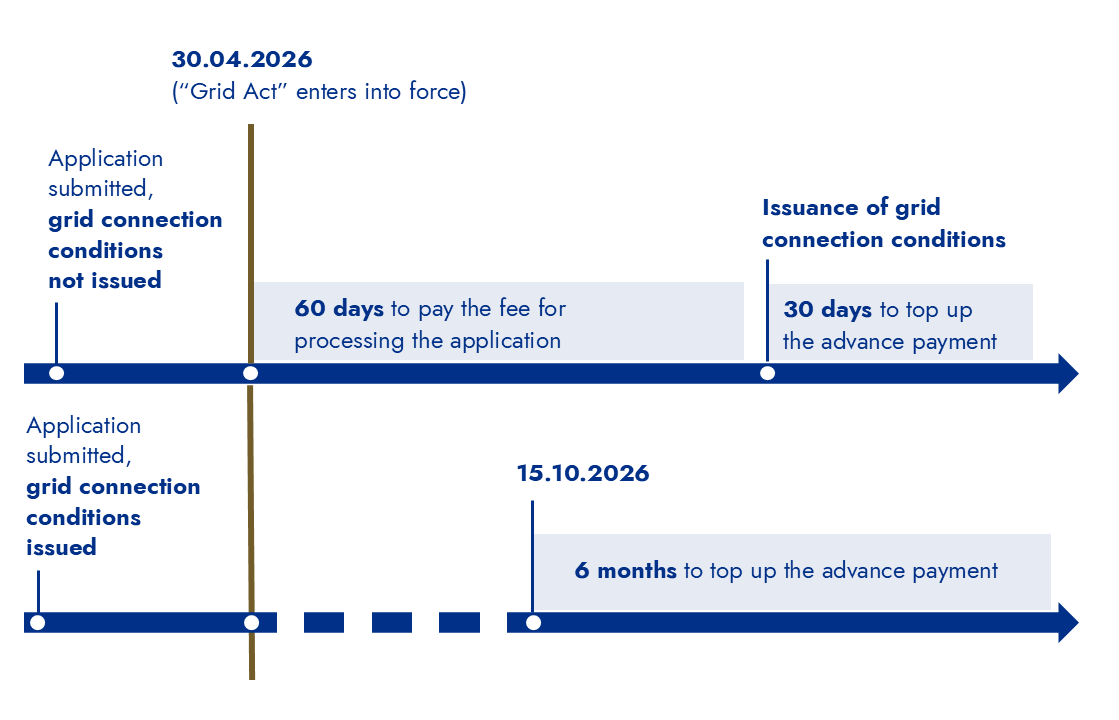
If an application for grid connection conditions has not been processed by 30 April 2026 and, under the previous regime, an advance payment was required, the investor will have 30 days from receipt of the grid connection conditions to top up the advance payment. Failure to do so will result in the issued grid connection conditions losing validity. The investor will also have to pay, by 29 June 2026, a fee for submitting the application for grid connection conditions of approx. EUR 235 per MW.
Case 2: Grid connection conditions issued before the amendment
Investors who have secured grid connection conditions before 16 October 2026 but have not yet entered into a grid connection agreement, will be required to top up the advance payment for the grid connection fee by 15 April 2027. Failure to top up the advance payment will result in the grid connection conditions losing validity. It is worth noting that these regulations will enter into force later than most provisions of the amendment, namely on 16 October 2026 and not 30 April 2026. This may give rise to doubts in interpretation, especially if the grid connection conditions are issued, say, on 10 June 2026. Due to the ambiguous wording of the amending act, the deadline for topping up the advance payment may be either 10 July 2026 or 15 April 2027. For safety, we recommend taking a conservative approach.
Financial security for planned (but also already implemented) projects
Another important new feature is the obligation to establish security for the performance of obligations under the grid connection agreement. The security must be provided within 14 days from the date of conclusion of the grid connection agreement, failing which the agreement expires by the operation of law. These provisions apply also to ongoing projects with issued grid connection conditions or signed grid connection agreements.
An applicant for connection must provide security in the amount of:
- approx. EUR 7 for each kW of connection capacity up to 100 MW;
- approx. EUR 14 for each kW of connection capacity exceeding 100 MW.
The maximum amount of security is capped at approx. EUR 2.8 million.
The Grid Act provides several permitted forms of security. It may be in the form of a cash deposit, a bank guarantee, an insurance guarantee, or a guarantee issued by the parent company of the capital group.
The obligation to provide security constitutes a significant tightening of the investment regime. This mechanism shifts a substantial part of the risk to the investor by requiring earlier capital commitment and greater discipline in project execution, which is intended to prevent the blocking of grid connection capacity.
Existing grid connection conditions and grid connection agreements subject to the new security regime
If an application for grid connection conditions is processed by 16 October 2026, or if by that date a grid connection agreement is concluded with a connection date later than three years, the investor will be required to provide security of one quarter of the full security amount. However, if the application for grid connection conditions is processed after 29 April 2026, the security must be provided in full. As in the case of topping up an advance payment for the grid connection fee, doubts arise as to the amount of security required when the grid connection conditions are issued after 29 April but before 16 October 2026.
Introduction of milestones
Another instrument tightening the investment regime is the introduction into grid connection agreements of an obligation for the connecting entity to meet “milestones”. Under the new rules, the investor is not only bound, as before, by the deadline for connecting the installation to the grid, but is also required (within 24 months for PV and electricity storage, or 36 months for wind farms), to:
- conclude the grid connection agreement
- obtain a final building permit
- notify the operator of this by the statutory deadline.
Failure to submit the notification on time causes the grid connection agreement to expire by operation of law. At the same time, the amendment introduces the possibility of excusing a delay, if due to objective reasons. It will also be possible to extend this deadline by not more than 24 months, provided that additional security is submitted of approx. EUR 14 for each kW of connection capacity, but not more than approx. EUR 2.8 million. This is an additional security, separate from the security submitted after the conclusion of the grid connection agreement.
It is worth noting that the amended rules (similarly to the requirement for security), apply also to entities that already had grid connection agreements in place when the amendment entered into force. These entities are required to obtain a building permit within 30 months (for PV and electricity storage projects), or 42 months (for wind farms), from the entry into force of the amendment - which, for this provision, will occur in mid-October 2026. These deadlines, as in the case of new investment projects, may be extended by up to 24 months, but in this case the security to be provided is half of the amount described above.
The above does not apply to entities that concluded a grid connection agreement before 15 October 2022. In their case, the relevant deadlines are, respectively, three and six months and cannot be extended.
Temporary generation of electricity without a licence
The amendment also introduces significant operational facilitations for which the industry has been calling for years. Among other things, it regulates the so far informal rule that an electricity generator may offer electricity generated from its installation on the balancing market without holding a required licence. Under the amendment, for not longer than 12 months, such a generator may:
- sell electricity (excluding to end users)
- store electricity
- participate in the balancing market
- provide system services.
For these activities, generators will be required to pay a pre-licence fee, which will, as a rule, equal the licence fee.
Facilitations for electricity clients and greater competition between suppliers
Another significant facilitation for market participants is enabling electricity clients to install, within their existing grid connections, more than one consumption point, provided that the total power consumed at each consumption point does not exceed the connection capacity.
This is linked to the possibility of clients entering into more than one electricity supply agreement. Until now, there was no problem for one client with production plants operating in different locations in Poland concluding different supply agreements. Therefore, the express right introduced by the amendment for concluding more than one electricity supply agreement should be understood as referring to multiple agreements for a single grid connection. However, it remains an open question whether the conclusion of two electricity purchase agreements will require the installation of an additional consumption point, or whether these issues should be treated separately.
Igor Hanas, partner; Rafał Pytko, senior associate; Energy Practice, Wardyński & Partners